A Journal of Latin American Criticism & Theory
Vol. 4, No. 2 (2026)
This issue of FORMA brings readers three essays on Brazilian art and cinema, featuring analyses of work by the authors Solano Trindade, Abdias do Nascimento, and Ferreira Gullar; by Concrete/Neoconcrete visual artists; and by directors Eduardo Coutinho and Kleber Mendonça Filho. The issue also features an interview with Argentine filmmaker Alejo Moguillansky as well as the translation of an interview with Diego Rivera, which was originally published as a vinyl record recording in the United States in 1958.
Diego Rivera on Record in Spanish: What is the Social Role of the Artist?

If you buy a book of poetry, what are you paying for? Are you paying for the paper the poetry is printed on? The cost of its binding? The chosen weight of paper? The potential use of that paper for something other than reading? Surely not. The same thing happens with sculpture. What you are paying for is not the price of stone or the price of bronze. You pay for that. But in addition to it, you pay for that which is neither the quality nor the value of the metal or the stone. Thus, what you are paying for is the quantity of a capacity for feeling, the quantity of creativity, the quantity (eventually) of innovative achievement, the labor accumulated by the artist to execute the work. That is, you are paying for art: because you need it, and the rest of society needs it for their survival.
Back to the Origins of Cinema: Cinema and Its Relationship with Other Arts

These materials are a starting point where you begin to think, or work, or film something without any horizon, so the film is born as a possible variation of that material that is going to experiment a kind of development. It helps me a lot to think about the idea of reverse shot. To think about the idea of reverse shot as a kind of place, almost of editing, of editing between two images which is above all what cinema is made of. This, and not the script, is the starting point of a film.
Bodies and Breath: Brazilian Experimental Poetics of the 1950s

The late 1940s and 1950s in Brazil were a transitional phase in which artists across media actively experimented with embodied approaches to poetics, and with breath as key to formal organization. By “poetics” I do not mean a literary genre, but a set of compositional principles that structure sensory experience. The approach is often performative: language is scored, recited, and enacted; poems circulate beyond the page, appearing in galleries or staged as musical performances. If these works were intermedial, this was less a rejection of medium specificity than a relocation of form into embodied performances centered on activating the breath. What links otherwise disparate practices is not a shared style, medium, or political program, but a common compositional problem: how to re-ground avant-garde form after the erosion of nationalist modernisms, without retreating either into expressive immediacy or abstract universalism.
Melodrama in Playing and Brazilian Peripheral Modernism
While melodrama plays on the impossibility of separating the fiction constitutive of the participants’ narratives from reality (which would seem to include the experiences of the audience ), it is worth emphasizing that the question posed by the film is not that of fiction versus reality, but rather of fiction versus non fiction—that is, between socio-historically constituted perceptions articulated through narrative, regardless of whether or not they refer directly to reality. The referential blurring produced by the film, however, pushes the question further: it is no longer a matter of what is being referred to, but instead of how reference itself is constructed. For this reason, some scholars who have addressed Playing argue that the film comes closer to the essay form. As it proceeds, Playing gives rise to an opaque mode of writing and the artistic character of Coutinho’s film.
The Existence of Brazil
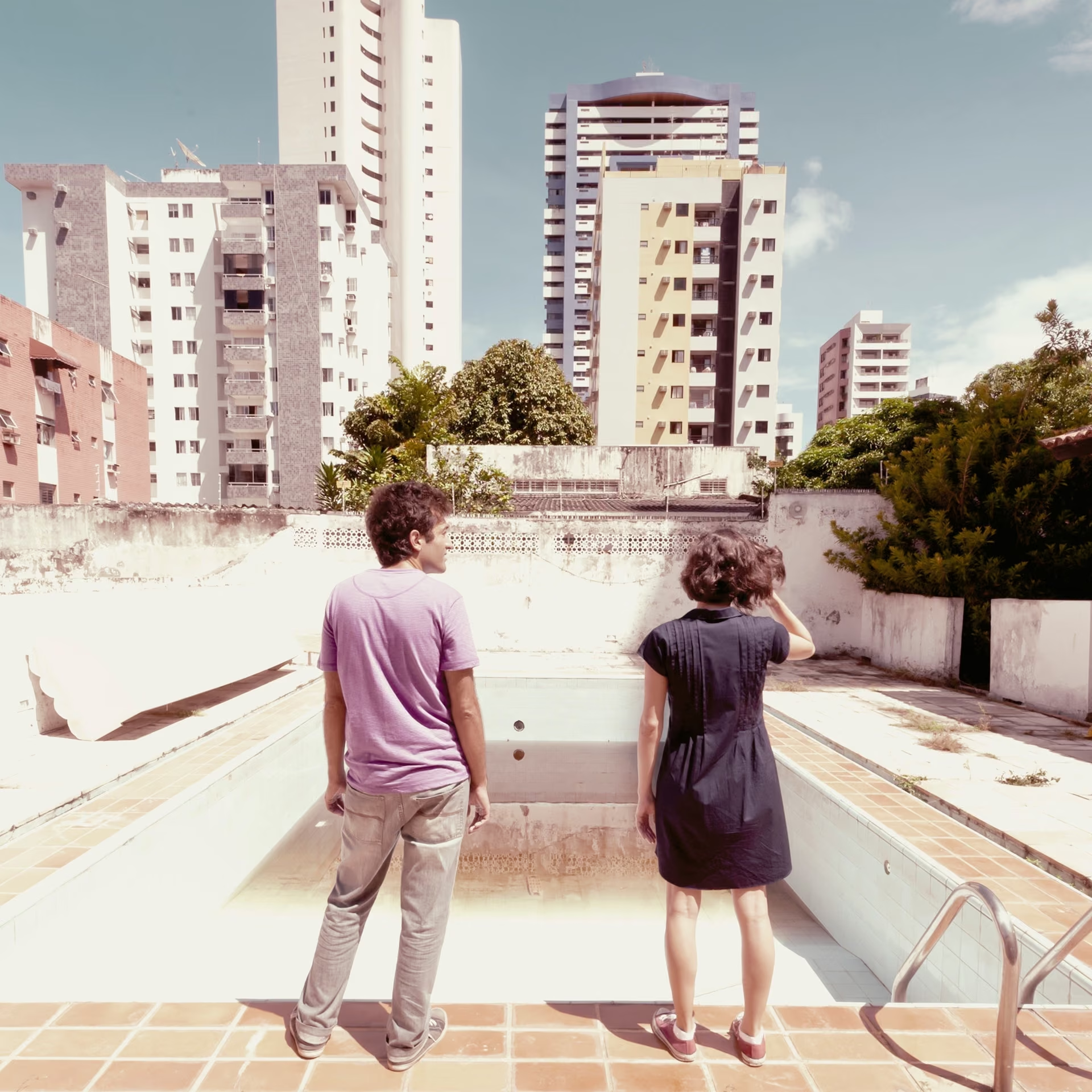
Mendonça’s Neighboring Sounds indexes the thirteen years of the PT’s ascendancy (from Lula’s election in 2003 to the parliamentary coup that ousted Dilma Rousseff in 2016), which saw a profound reorientation of politics toward addressing Brazil’s deep-rooted social inequalities. Spurred on by the commodities boom of the 2000s, Lula’s administration combined rapid economic growth with redistribution policies, which increased access to formal employment, doubled the enrollment in universities, and produced a historic reduction in poverty. For the first time in Brazil’s history, the poor appeared to finally have a pathway into the middle class. And yet, as we will see, Neighboring Sounds suggests why this history should not be taken at face value. Mendonça’s sharp focus on a single neighborhood allows him to explore broader social and historical forces that not only birthed this “new middle class” but also precipitated a profound shift in Brazilian class politics—a shift that culminated six years later with far-right candidate Jair Bolsonaro winning the presidency. How exactly a film like Neighboring Sounds goes about making those forces visible is the focus this essay, and, by exploring this issue, we might also come to view Mendonça’s film as raising broader questions about cinema as an art form more generally.